The Overlooked Blood Test Changing How Women Over 40 Understand Their Fatigue
Women in perimenopause have been told for years that their exhaustion, thinning hair, and brain fog are just part of getting older. A growing body of research — and a generation of women finally asking the right questions — is telling a different story.
When Maria, 47, walked into her doctor's office last spring, she had a list.
She was tired in a way that sleep didn't fix.
Her periods had turned unpredictable, heavy, clotted, sometimes twice in a month.
She was finding hair on her pillow. She was forgetting words mid-sentence.
Her doctor ordered a complete blood count, the standard panel run at annual physicals.
Aweek later, the results came back: hemoglobin normal, white blood cells normal, everything "in range."
Maria was told her labs looked fine.
They weren't.
A nurse friend, hearing the full story, asked a specific question: Had they checked ferritin?
The answer was no.
A second appointment and one additional test later, Maria had the number that explained nearly every symptom she'd been carrying for three years: a ferritin level of 12 ng/mL.
Many women in their 40s are walking around with severely depleted iron stores — and standard bloodwork misses it entirely.
Maria's story has become so common among women in their 40s and early 50s that clinicians specializing in perimenopause now point to it as a pattern.
It's also at the heart of a quiet shift in how women's health is being practiced, one that revolves around a single blood test most women have never been offered.
The gap between "normal" and "optimal"
The test Maria eventually received was a ferritin panel — a measurement of the protein that stores iron in the body.
Standard annual bloodwork typically measures hemoglobin, which reflects current oxygen-carrying capacity.
Ferritin reflects the underlying reserves. A person can have "normal" hemoglobin while her ferritin is already severely depleted — the iron equivalent of a nearly empty gas tank in a car whose engine is still running.
The distinction has begun to matter more as researchers examine what "normal" even means.
U.S. labs commonly list ferritin as within range starting around 15 ng/mL.
But a growing consensus in functional medicine and women's health points to 50 ng/mL as a more meaningful threshold for well-being — below which fatigue, hair thinning, and cognitive symptoms become common.
Lab ranges show what's common, not what's optimal. Ferritin below 50 ng/mL is linked to fatigue, brain fog, and restless legs — even when hemoglobin reads as normal.
— Dr. Brittany Schamerhorn, functional medicine physician
In Maria's case, the number was below 15. She'd been running a years-long deficit that no one had thought to measure.
Why perimenopause changes the math
The arithmetic of iron loss in midlife is brutal when you actually look at it.
A typical menstrual period loses 30–40 milliliters of blood. A heavy one — increasingly common in a woman's 40s — can be three or four times that.
Each milliliter of blood contains roughly half a milligram of iron. Over months and years, the loss adds up faster than food can replace it.
A 2024 study in the journal Menopause followed more than 2,300 midlife women and found that roughly one in three experience abnormal uterine bleeding during perimenopause — longer periods, heavier flow, or cycles that come too close together.
The researchers concluded that this bleeding pattern was directly associated with midlife fatigue.
What's striking is how often the two are discussed separately.
Heavy periods get attributed to "hormones." Fatigue gets attributed to "age" or "stress" or "perimenopause" in a vague, unexamined way.
Few women in their 40s are told that the two might be part of the same equation - a slow, silent depletion of iron that compounds over years.
For Maria, putting the two together took months of her own research, after conventional advice had left her with no answers.
The symptoms research links to low ferritin
Peer-reviewed literature has documented a consistent set of symptoms in women with low iron stores. The list below reflects the findings commonly cited in clinical reviews:
- Persistent fatigue that sleep doesn't fully resolve
- Hair thinning and increased shedding
- Brain fog, word-finding difficulty, and slowed cognition
- Shortness of breath during mild exertion like climbing stairs
- Restless legs at night
- Heart palpitations or a racing sensation
- Lower mood, motivation, or a flat emotional baseline
- Brittle nails and pale complexion
Notably, this list overlaps almost entirely with the symptoms women associate with perimenopause.
Which is precisely why clinicians have begun advocating for ferritin screening as a standard part of midlife women's health - not to replace hormonal assessment, but to rule out a concurrent deficiency that may be driving much of the discomfort.
The problem with traditional iron pills
Once iron deficiency is identified, the standard treatment is straightforward in theory: take iron.
In practice, it's where most women's stories go sideways.
Ferrous sulfate, the workhorse of oral iron supplementation, has what the medical literature politely calls "poor tolerability."
Nausea.
Constipation.
Abdominal cramping.
A metallic taste that lingers for hours.
Empty-stomach protocols that are difficult to maintain.
Interactions with calcium, coffee, tea, and most comforts of daily life.
The compliance data reflects this.
Research has estimated that half or more of women prescribed oral iron stop taking it within weeks due to gastrointestinal side effects.
This is the clinical reason iron deficiency remains so persistent in midlife women: not because iron is unavailable, but because the delivery method fails the people who need it.
Iron deficiency persists not because iron is unavailable, but because the delivery method fails the people who need it.
The problem compounds in perimenopause, when digestive sensitivity often increases.
Women who could tolerate iron pills in their 20s find themselves unable to keep them down in their 40s.
And even when the pills stay down, absorption suffers - gut-level inhibitors can block a substantial portion of the dose before it ever reaches the bloodstream.
A different approach gaining traction
In the last several years, a different delivery method has begun to gain traction in the supplement space: buccal absorption, the release of a compound through the mucous membrane lining the mouth.
The technique is well-established in medicine - used for nitroglycerin, certain hormone therapies, and some vitamins - and bypasses the digestive system entirely.
A growing number of women's health brands have applied the approach to iron.
Among them is OYO, a company that developed a dissolvable iron strip formulated specifically with midlife women in mind.
The strip contains 19 mg of ferric saccharate , a gentler form of iron than ferrous sulfate alongside 400 mcg of folate to support red blood cell production.
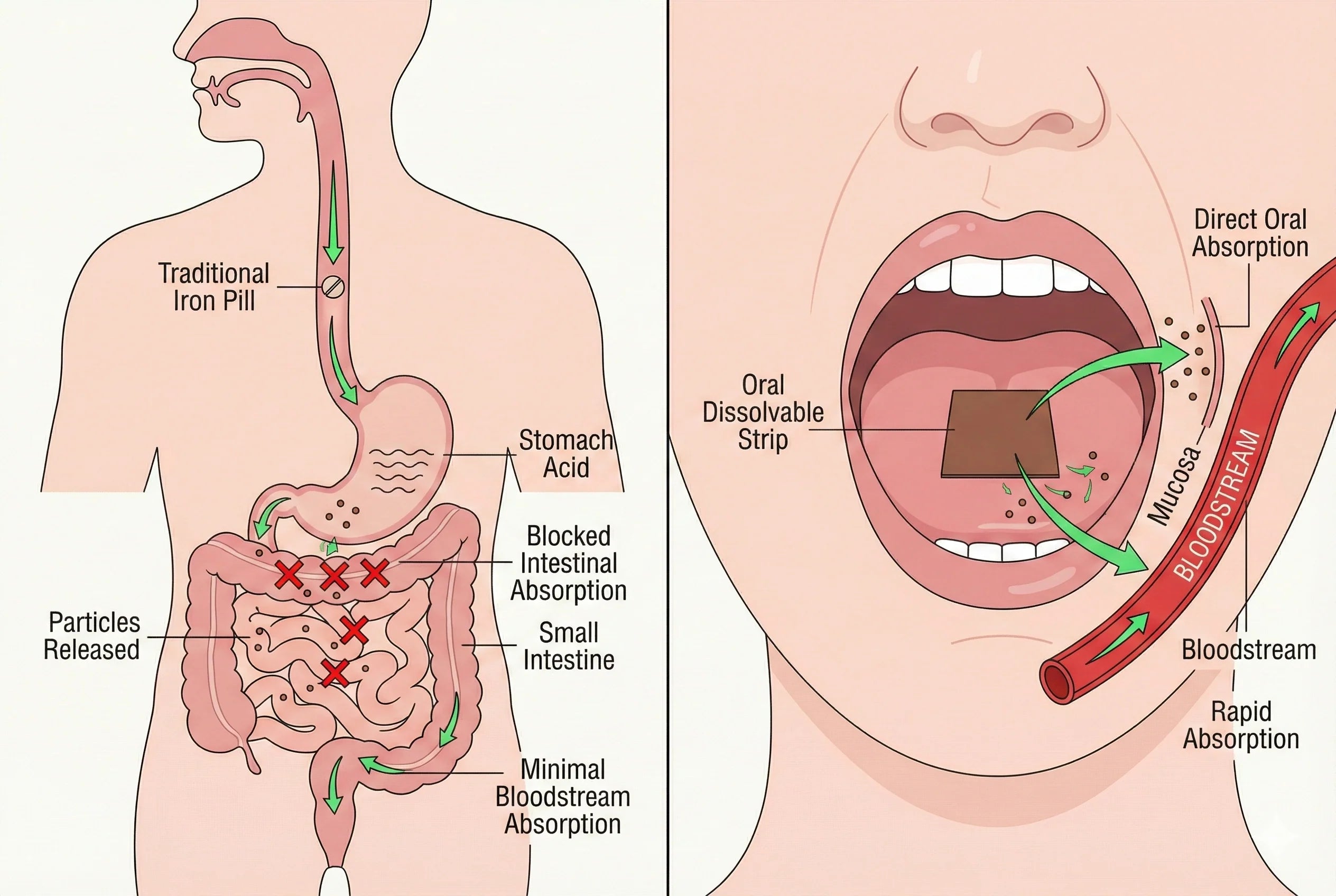
The premise is simple: place the raspberry-flavored strip on the tongue.
It dissolves in roughly 30 seconds. The iron is absorbed through the oral mucosa, the vascular tissue inside the mouth, and enters the bloodstream without passing through the stomach.
No empty-stomach rule.
No digestive side effects.
No interaction with coffee or meals.
The approach appears to solve the compliance problem that has plagued traditional iron supplementation.
In customer surveys reported by OYO, 94% of users said they experienced no stomach discomfort while taking the product and 88% reported staying consistent with daily use for 60 days or more, a rate dramatically higher than what's been observed with oral iron pills.

IRON GLOW UP STRIPS
What women are reporting
The clearest signal of the approach working comes from women themselves. Among them is Sarah K., a 48-year-old OYO user whose experience tracks closely with Maria's.
My ferritin was stuck at 18 for two years on pills — I'm 48 and my periods have been brutal. I switched to OYO and tested again at three months: 65. No nausea, no bathroom drama, just results.
— Sarah K., OYO customer
Individual results vary. Sarah's experience reflects her personal use and may not be typical.
Stories like Sarah's have become increasingly common in the brand's reviews, women in their 40s and 50s reporting measurable ferritin increases on follow-up bloodwork, after years of stalled progress on conventional iron pills.
The shared thread: they finally found a format they could actually stay consistent with.
What women in midlife are being encouraged to do
The takeaway from recent research and clinical practice isn't that every woman over 40 needs iron supplementation.
It's that every woman over 40 deserves to know her ferritin number - and to have the information it provides factored into her care.
Physicians specializing in midlife women's health increasingly recommend the following steps:
- Request a ferritin test specifically at the next annual physical, not just a standard CBC
- Ask the provider about the optimal range, not just the "normal" cutoff — levels above 50 ng/mL are considered optimal by many functional medicine practitioners
- Track menstrual patterns, particularly any recent changes toward heavier, longer, or more frequent periods
- Discuss supplementation with a qualified healthcare provider before starting any new iron product, especially if pregnant, nursing, or managing a medical condition
Iron is one of the few nutrients where both deficiency and excess carry real risks.
Self-supplementation without bloodwork is not recommended.
But for women whose ferritin comes back below optimal, as Maria's did, and as Sarah's did before her, the question becomes less "should I supplement" and more "what form of iron can I actually tolerate long enough to rebuild."
For a growing number of women, the answer is turning out to be a strip that dissolves on their tongue in 30 seconds.

Formulated for Women in Perimenopause and Menopause
One raspberry-flavored strip a day — no pills, no stomach upset, no meal timing.
- 19mg Ferric Saccharate + 400mcg Folate per strip
- Buccal absorption — bypasses the digestive system entirely
- 60-day money-back guarantee
- Free shipping on every order
60-day money-back guarantee · Free shipping · Cancel anytime
What to ask your healthcare provider
Before starting any iron supplement, a conversation with a qualified healthcare provider is strongly recommended. The questions below may be useful to bring to the next appointment:
- Can I get a ferritin test in addition to my standard bloodwork?
- What is my current ferritin level, and how does it compare to the optimal range?
- Have my recent periods been medically considered heavy or prolonged?
- Given my current levels and cycle patterns, would iron supplementation be appropriate for me?
- What form of iron would be best for my tolerance and absorption?
A qualified provider can review bloodwork, rule out other causes of symptoms, and offer individualized recommendations — the most important step anyone can take before beginning supplementation of any kind.
IRON GLOW UP STRIPS
This article is an advertorial intended for informational and educational purposes. Individual experiences referenced reflect personal use and are not representative of all users. This content is not medical advice and should not be used to diagnose or treat any condition. Readers experiencing symptoms of fatigue, hair loss, or menstrual changes should consult a qualified healthcare provider for evaluation and individualized guidance, including before beginning any new supplement regimen.
These statements have not been evaluated by the Food and Drug Administration. This product is not intended to diagnose, treat, cure, or prevent any disease. Individual results vary. Consult your healthcare provider before starting any new supplement, especially if you are pregnant, nursing, managing a medical condition, or taking medication.